Authorized Partner of Container One, A+ BBB rated, 30 years in the container industry.
Statewide Coverage

Service Areas

We deliver from Philadelphia to Pittsburgh, from Erie to Gettysburg, and everywhere in between. The price always includes delivery to your address.

Pennsylvania covers roughly 44,700 square miles and 67 counties, and the ground under a truck changes five separate times between the Delaware River and the Ohio line. The southeast corner is coastal plain at Philadelphia rising into the rolling Piedmont of Chester, Lancaster, Berks and York, which is deep, well drained farm ground and the best delivery surface in the state. Behind it stands the Great Valley, a single long limestone trough that carries the Lehigh Valley, the Lebanon Valley and the Cumberland Valley, where carbonate rock sits close under the soil and sinkholes are a normal part of building. West of that the ridges start, long parallel folds running southwest to northeast, and the roads either follow a valley or find a gap through. The Allegheny Front is the hard line: east of it the country is ridge and valley, west of it the whole northern and western half of the state is a dissected plateau, high and cut through by steep hollows rather than folded into ridges. Then the far northwest corner drops to the flat lake plain at Erie. Pennsylvania is close to sixty percent forested, holds more covered bridges and more township maintained road miles than almost any other state, and has 2,560 separate municipalities deciding what happens on those roads. Delivery planning here follows that geology and that patchwork far more closely than it follows the interstate map, because grade, surface and turnaround decide what a truck can actually set down.

Distance from the nearest depot is most of what moves a delivered price, which is why we ask for a ZIP code before quoting. Give us yours, in the form below or by calling (330) 510-5817, and we will confirm the route and the timing for your exact location.

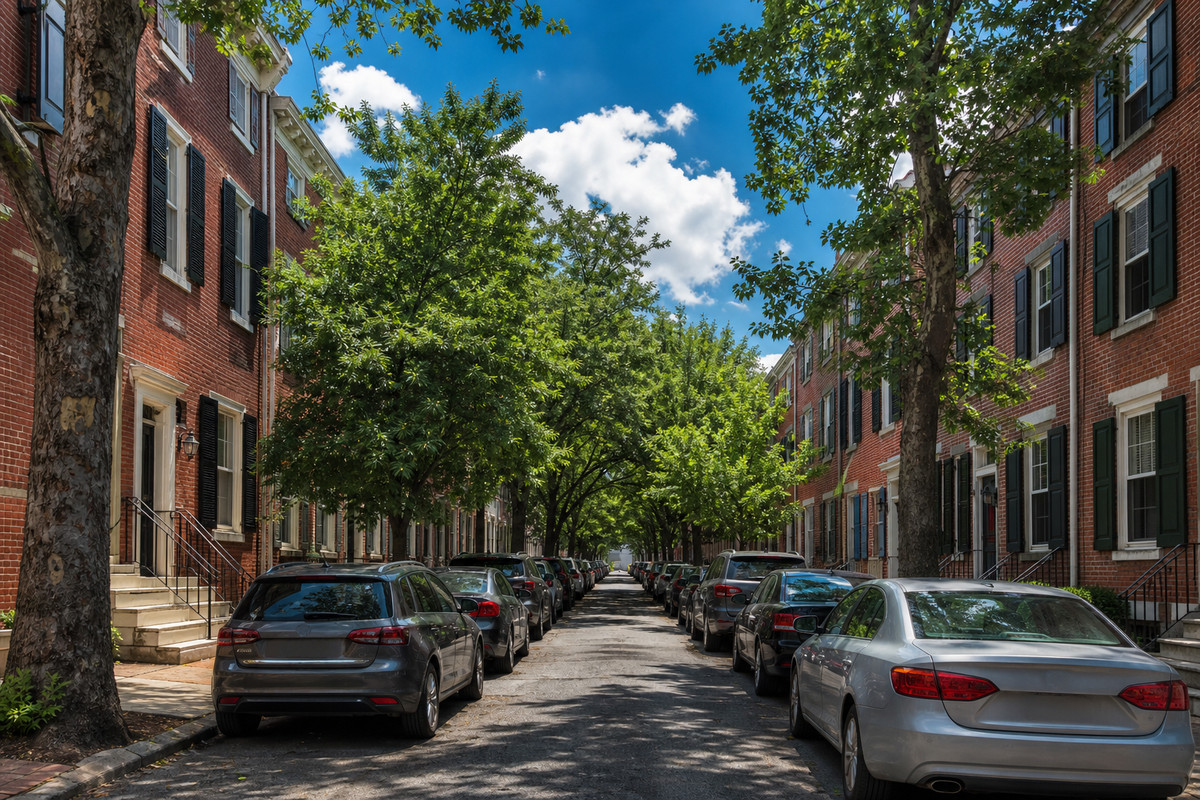
Narrow Philadelphia rowhouse street with marble stoops, parked cars on both sides and Center City towers rising behind the roofline

Philadelphia and the Collar Counties

The city, the Main Line, Delco, Montco, Bucks and Chester County. Our highest volume map, and the one where the last hundred feet decides everything. Typical delivery 1-2 weeks.

Southeastern Pennsylvania is our busiest map and the Newark depot sits about 86 miles away, so distance is almost never the problem here. The last hundred feet is. Philadelphia is a rowhouse city, which means block after block with cars parked both sides, no rear access, marble stoops right at the sidewalk, and street trees that were planted when nobody was delivering forty foot boxes. In the older wards you add Belgian block, one way grids and trolley track set into the cartway. We ask three questions before we book a Philadelphia date: how wide is the street, is there a service alley behind the row, and how high is the lowest wire or limb over the drop spot, because a tilt bed has to raise its bed to slide a container off. Out in the collar counties the picture changes county by county. The Main Line and the older Montgomery County townships have long curving drives under mature hardwoods, so limb height matters more than gate width. Chester County is farms, horse properties and the mushroom houses around Kennett Square, where there is usually plenty of room and firm ground. Bucks County runs from tight Levittown streets to open ground north of Doylestown. New construction anywhere in the four counties means soft backfill over fresh utility trenches, so we ask where the water and sewer taps run before we set a box that has to sit level for years. Scheduling works around the Schuylkill and the Blue Route at rush hour, and around the Mummers on New Year's Day and the Flower Show week in March.

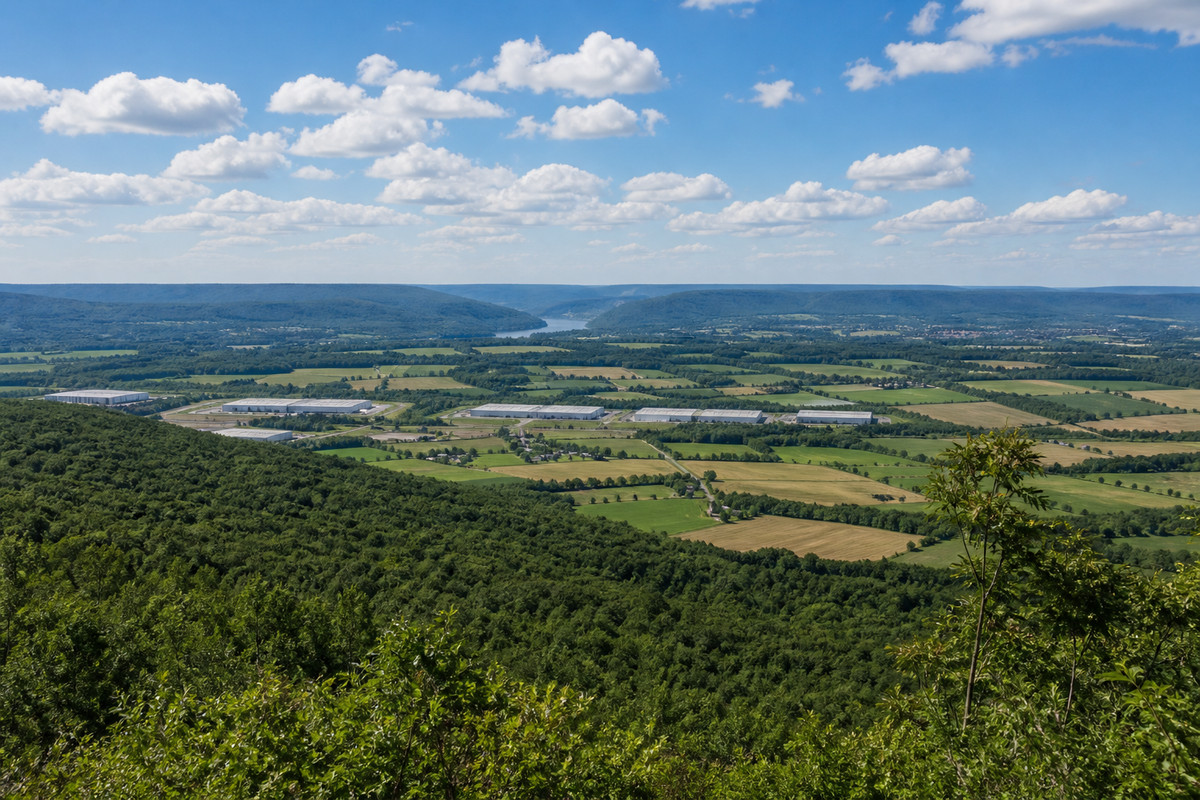
Blue Mountain ridge above a Lehigh Valley farm field with a stone bank barn in the middle distance and a cement plant stack on the horizon

The Lehigh Valley and the Poconos

Allentown, Bethlehem and Easton, out through the gaps into the Pocono resort country. The shortest depot run in Pennsylvania. Typical delivery 1-2 weeks.

The Lehigh Valley is the shortest run we have in Pennsylvania, about 82 miles from the Newark depot, and it is also the part of the state where commercial demand is heaviest per square mile. The warehouse belt along Interstate 78 and Pennsylvania 33 has been building for two decades, and third party logistics operators, seasonal fulfillment sites and carriers around Bethlehem, Easton and Fogelsville order containers as yard storage they control rather than paying per diem on somebody else's box. Cement country north of Allentown, around Nazareth, Whitehall, Coplay and Bath, buys for parts and belting. Ground here deserves a real conversation, because the Great Valley floor is carbonate rock close under the soil and sinkholes are a normal part of building in Lehigh and Northampton counties. We ask what the site history is and we recommend blocking at the four corners rather than setting straight on turf, which is cheap insurance on any lot and sound practice on this one. North and east of Blue Mountain the work turns seasonal. Pocono resort operators, campgrounds, marinas and short term rental managers store gear through the off season, ski areas store snowmaking equipment through summer, and the camp roads back into Monroe, Carbon, Pike and Wayne counties are narrow, steep and often gated. A gravel camp lane that a pickup runs all summer will not always take a loaded trailer in March, so we ask about the last half mile and we build slack into late winter schedules. Musikfest week in Bethlehem and race weekends at Pocono Raceway are worth planning around rather than through.

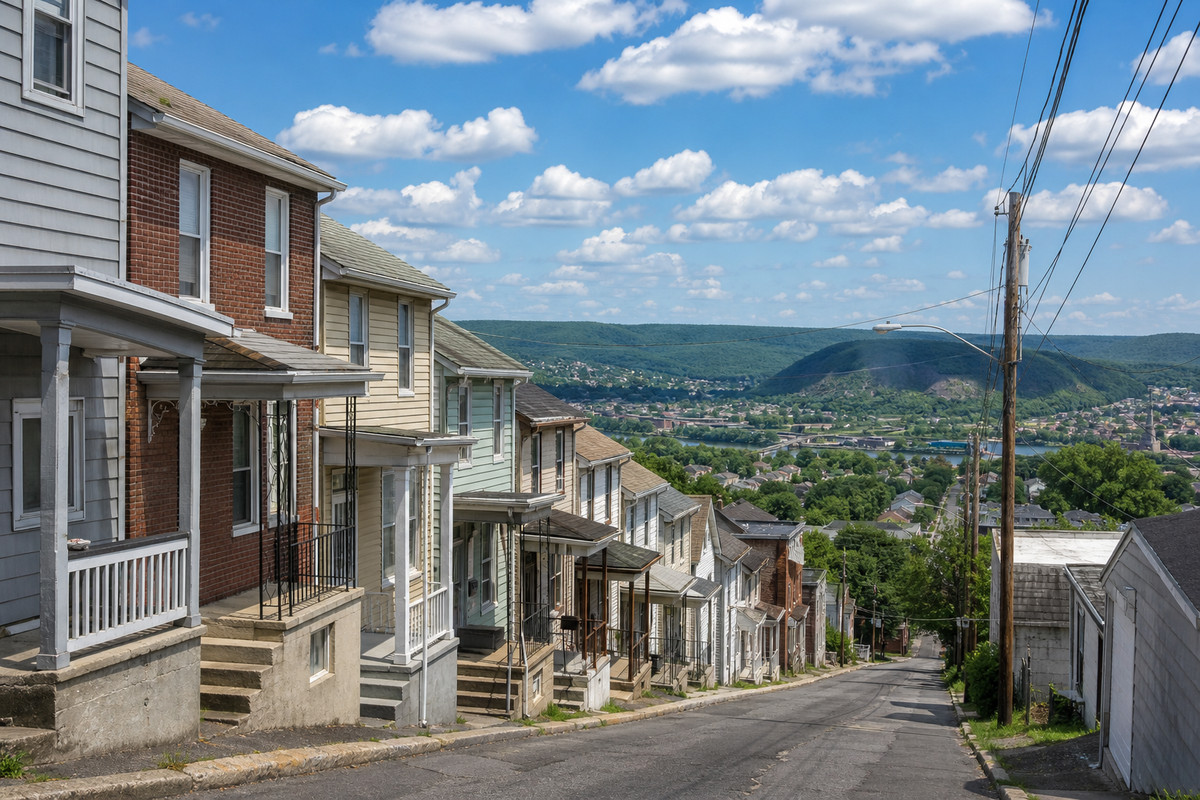
Steep narrow street of close set frame houses in an anthracite borough with a wooded culm bank rising behind the rooftops

Northeastern Pennsylvania and the Coal Region

NEPA, the Wyoming Valley and the anthracite boroughs. Tight old streets, ground with a history, and a warehouse corridor running through the middle of it. Typical delivery 1-2 weeks.

People here say NEPA and mean it, and the region has a delivery character that is genuinely its own. The boroughs were laid out around anthracite, which means narrow streets, houses close to the curb, alleys instead of driveways, and hills steeper than the map suggests. In Scranton, Wilkes-Barre, Pittston, Pottsville and the Schuylkill County boroughs we ask about the alley behind the property as often as we ask about the street in front of it, because the alley is frequently the only way in. The second question is ground. This is coal country, culm banks are part of the landscape, and some parcels sit over old workings. That is not a reason to avoid a site, it is a reason to talk it through and to know what is under the spot before a box goes on it. The middle of the region is a different business entirely. The Interstate 81 corridor through Pittston and Hazleton is one of the busiest distribution belts in the eastern United States, and those customers order in volume for yard storage and seasonal surge. Along the North Branch of the Susquehanna, through Bloomsburg, Berwick, Danville and Sunbury, the flat ground near the river is the best farming and the worst storing, so we talk about the flood plain honestly and usually set the box on higher ground a hundred feet back. Runs from the Newark depot are short and steady. The Bloomsburg Fair in late September and the winter freeze thaw cycle are the two things that move a date.

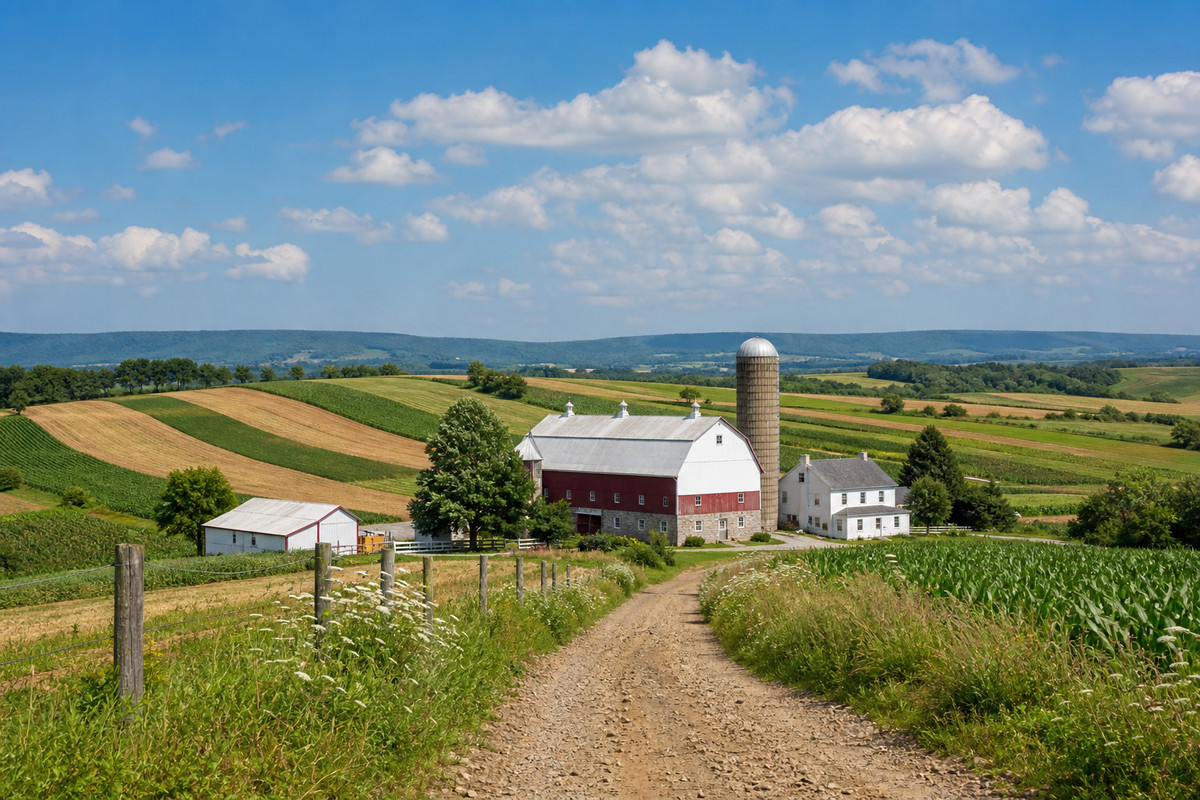
Rolling Lancaster County farmland with a white stone bank barn, a fenced lane and contour strips of corn running up to a distant ridge

Pennsylvania Dutch Country and the Susquehanna Valley

Lancaster, Reading, York, Harrisburg and the Cumberland Valley. Some of the best farm ground in the country, and some of the most patient driving. Typical delivery 1-2 weeks.

This is the part of Pennsylvania most people picture, and it is a genuinely good place to set a container. Limestone ground through Lancaster, Lebanon and the Cumberland Valley drains well and carries weight, farm lanes are built for equipment far heavier than our trucks, and produce auction lots and equipment yards are usually packed hard enough to work from. The one ground caution is the same carbonate geology that makes the farming good, because sinkholes turn up in the Great Valley from Reading through Carlisle, so we ask about site history the way we would ask about a septic field. Agriculture is the backbone of the demand here. Dairy, poultry, produce and greenhouse operations buy for feed, packing supply and equipment, and the bank barns that define the landscape are wonderful buildings that happen to eat the only level ground on a lot with their earthen ramps. Driving through the Plain communities on Pennsylvania 340, 772 and 23 takes patience and a little courtesy, because horse drawn traffic is normal and passing is not always possible. We plan those runs for the middle of the day and we do not rush them. West and south, Harrisburg, Carlisle and Mechanicsburg carry the Interstate 81 warehouse trade and the state government market, York runs on manufacturing and the snack food belt around Hanover, and Gettysburg runs on visitors. The Farm Show in Harrisburg every January and the antique car meet at Hershey every October are the two weeks we schedule around.

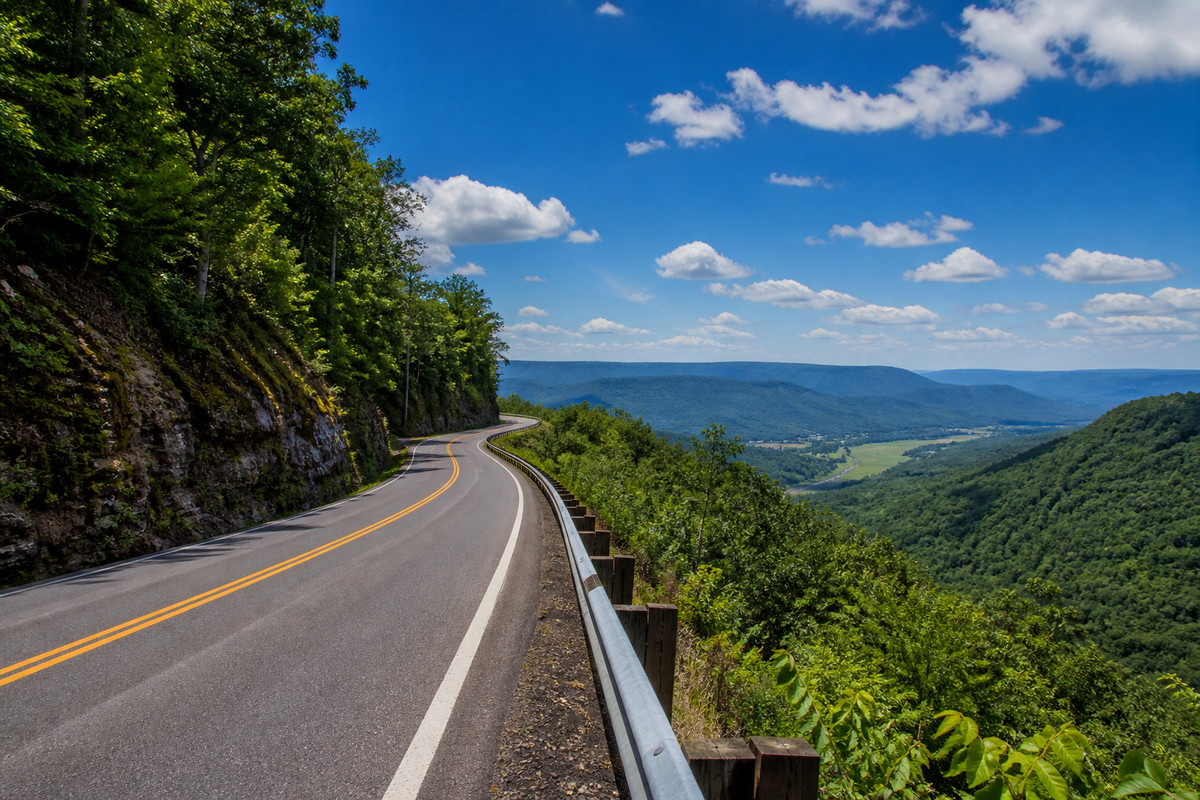
Two lane road switchbacking up a forested Allegheny ridge with a hardwood log landing on the shoulder and folded ridges receding behind it

Central Pennsylvania and the Alleghenies

State College, Altoona, Johnstown and Williamsport, out through the Northern Tier and the Pennsylvania Wilds. Our one honest long haul in this state. Typical delivery 2-3 weeks.

The middle of Pennsylvania is the one place in this state where we quote two to three weeks and mean it, and the reason is simple geometry. Our depots sit at Newark on one side and Cleveland on the other, and everything between State College, Altoona, Williamsport and Coudersport is a long way from both. We would rather tell you that up front than promise a date we have to walk back. Once a truck is here the work is often easier than in the metros, because there is room. The Allegheny Front is the dividing line and it changes everything about a route: east of it the roads follow the valleys, west of it they climb, and a switchback on a mountain grade is a real constraint for a loaded tilt bed. Above Interstate 80 the map thins out into the Pennsylvania Wilds, where the working economy is hardwood timber, powdered metal around St. Marys, and gas in the Northern Tier counties of Bradford, Tioga, Lycoming and Susquehanna. Gas pad access roads are built wide and firm and are some of the best surfaces we get. Camp roads are the opposite, often single lane, often gated, and frequently signed as not maintained for winter travel, which is exactly what it sounds like. Township roads here get posted with seasonal weight restrictions from late winter into spring, so we schedule around thaw rather than argue with it. Penn State home Saturdays fill State College seven times each fall, the Little League series fills Williamsport in August, and deer season quiets the whole region for a week.

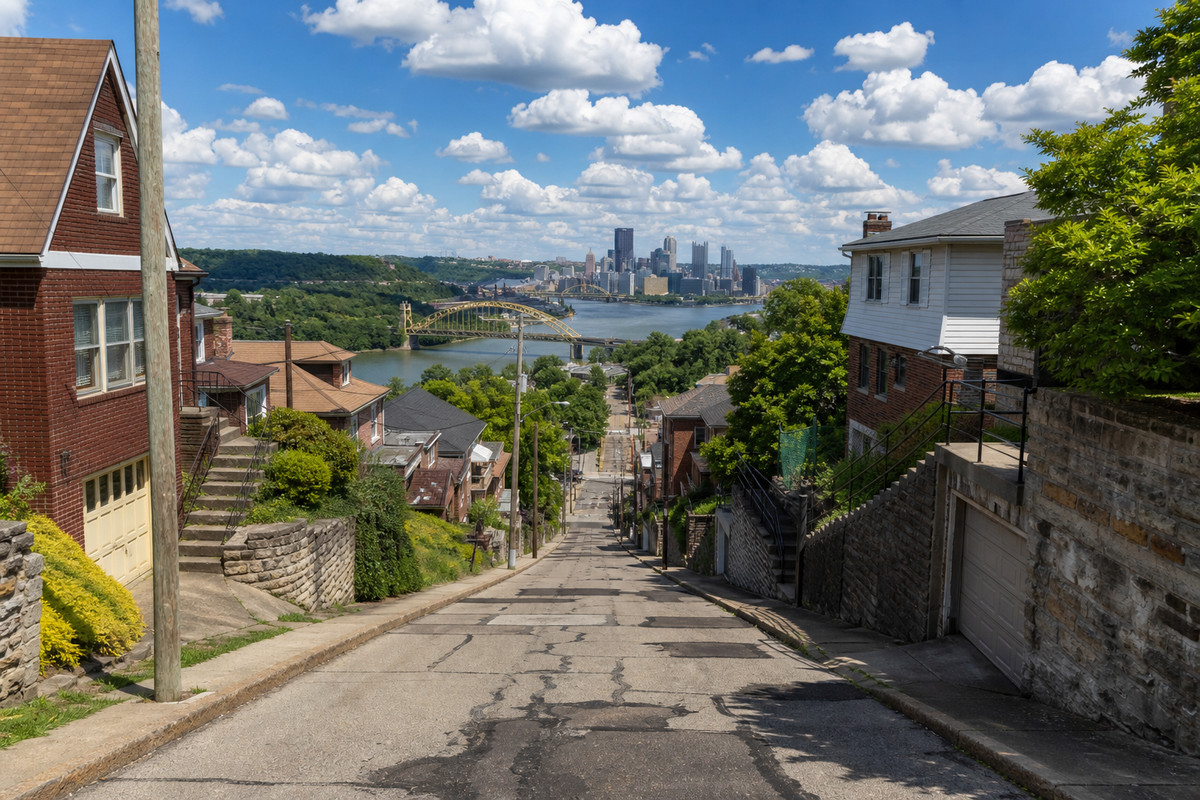
Pittsburgh hillside street of narrow houses climbing above a river valley with a yellow bridge and the downtown skyline framed beyond

Pittsburgh and Western Pennsylvania

The Burgh, the Mon Valley, the gas counties and the Erie snowbelt. Short runs from the Cleveland depot, and the steepest lots in the state. Typical delivery 1-2 weeks.

Western Pennsylvania is a comfortable run for us, because the Cleveland depot is about 132 miles from Pittsburgh and closer still to Erie, which makes the lakefront our fastest delivery in the state. What western Pennsylvania asks for instead is honesty about slope. Pittsburgh is built on hillsides above three rivers, and a lot of city and South Hills properties have a street too steep to stop a loaded truck on, a garage cut under the house, and public stairways where a street ought to be. We ask people to tell us the grade and to walk the route, and we plan around the Fort Pitt and Squirrel Hill tunnels and the Parkway, which set the window more often than mileage does. Ground out here is usually good. Slag and red dog drives are firmer than they look, and old industrial lots are generally the easiest sites in the region. Parcels over old mine workings deserve a conversation before a set, not after. Demand is broad. The Mon Valley steel and coke operations and their supply shops buy for stock and tooling, gas crews in Washington, Greene and Fayette counties buy for pad and pipeline storage, the petrochemical plant at Monaca pulled a whole contractor base into Beaver County, and Butler County growth around Cranberry keeps builders busy. Up at the lake, Erie takes roughly a hundred inches of snow most winters, so we set boxes with the doors facing away from the prevailing lake wind and we build slack into January.

Rural, Remote or Off-Road Property?

We deliver to properties that are not on paved roads, regularly. Tell us the access situation: how long the drive or track is, how tight the turns are, and anything the truck has to cross or pass under. Around here that usually means tar and chip, what Pennsylvania townships spread instead of paving, and what softens under a loaded trailer in July, macadam, the word most Pennsylvanians still use for a paved surface, berm, the Pennsylvania word for the road shoulder, and the first thing that gives way under an outrigger, township road maintained by a township crew rather than the state, which is most of the miles in this state, dirt and gravel road on a township maintenance rotation, seasonal road, not maintained for winter travel, which is a literal sign here and a literal answer to whether we can get in, posted road with a seasonal weight restriction from late winter into spring, weight posted township bridge with a limit low enough to turn a loaded truck around, covered bridge, of which Pennsylvania has more than any other state, nearly all of them posted, one lane iron truss bridge over the run, run, the local word for a small creek, as in the road follows the run the whole way in, crick bottom that stays soft for a week after the rain quits, hollow road with the creek on one side and the bank on the other and no place to turn, gap road through the ridge, as at Wind Gap, Lehigh Gap or Swatara Gap, notch, the local name for the cut a road takes over a mountain shoulder, switchback climbing the Allegheny Front, red dog road, the burned coal refuse western Pennsylvania townships spread on dirt lanes, culm bank, the anthracite waste pile that shapes half the back roads in the Coal Region, boney pile, the bituminous equivalent west of the Alleghenies, reclaimed strip job with a haul road still cut into it, ground over old mine workings, which is a conversation to have before a set, not after, slag drive, common on Mon Valley lots and firmer than it looks, cinder lane laid down when the railroad still ran through, farm lane running between two bank barns, bank barn ramp, the earthen ramp into the upper level that eats the only flat ground on the property, buggy lane along the shoulder in Lancaster and eastern Lancaster County, produce auction lot, packed hard and usually the best staging ground for miles, limestone quarry haul road, sinkhole ground in the Great Valley and the Lehigh Valley, where carbonate rock sits close under the soil, frost heave that lifts a gravel lane every March and drops it again in April, mud season on a dirt township road, camp road up the mountain to a hunting cabin, gated most of the year, state game lands gate at the end of a public road, gated forest road in the Allegheny National Forest, log landing at the top of a skid road, sugarbush lane through the maples in Somerset and Potter counties, well pad access road built wide and firm for gas traffic, one of the easier surfaces we get, pipeline right of way used as a back way in, flood plain flat along the river that farms beautifully and stores badly, rowhouse block with no rear access and cars on both sides, Belgian block street in the older Philadelphia wards, trolley track set in the cartway in West Philadelphia and Delaware County, service alley behind the row, city steps, the public stairways that stand in for streets on Pittsburgh hillsides, hillside street too steep for a loaded tilt bed to stop on, garage cut under the house on a South Hills lot, with the only flat ground on the roof of it. For most properties a standard tilt-bed handles it. Where it will not, we will say so before you order rather than after the truck arrives.

The more you tell us about the site, the more accurate the quote and the delivery estimate.

Get a Quote

Request a Delivery Quote for Your Pennsylvania Location

Your ZIP code and what you need. We confirm the delivery route and send a price.

Your details go to us and nowhere else. We use them to price your delivery.

Ready to Get Your Pennsylvania Container?

Call, text or use the form. We confirm delivery to your location and send one all-in price.